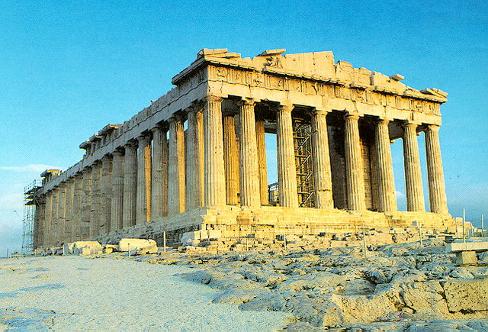
One of the best places to travel to is Greece. Greece is located in the south of Europe. Greece consists mainly of mountainous peninsulas. Rugged mountains cover about three-fourths of Greece. The sea shaped Greek civilization. Greece is surrounded by the Aegean Sea, the Ionian Sea, and the neighboring Black Sea. These seas were very important for transportation and trading routes. Because Greece is surrounded by peninsulas they have some of the best beaches in the world for relaxation. The different way to reach the beaches is by bus, rental car, or a boat. Make sure you bring your suntan lotion! Greece has a varied climate. Greece has temperatures averaging 48 degrees Fahrenheit in the winter and 80 degrees Fahrenheit in the summer. To be able to get to Greece it will be a very long and expensive plane ride, but it is definitely worth it. Below is a map of where Greece is located.
Religion:The Greeks were polytheistic, believing in more than one god. The Greeks believed that the gods controlled natural and social forces, and lived on Mount Olympus. People who denied the existence of a god were severely punished.The god Zeus was the supreme god who ruled and protected the other gods and people. They sacrificed animals in the temples. After they killed the animals, part of the them was burnt to honor the gods. They had processions which was a form of collective prayer often performed at dawn. They believed that prayers could reach the dead and help them in the after life. While you are in Greece there are many churches that you can visit. For example one of the churches is the Little Mitropolis in Athens. This chapel dates back to the 12th century. Its outer walls are covered with pictures of animals and religious figures dating from the classical to the Byzantine period. A tradition that you might see and could participate in is lighting candles for yourself and someone you love.
Rulers and government-Greek city-states had many different forms of government. In some city-states a single person, called a king, ruled in a government called a monarchy. Other city-states ruled by an aristocracy, a government ruled by a small group of noble, landowning families. Later, as trade expanded, a new class of wealthy merchants came to power. They formed an oligarchy, a government ruled by a few powerful people.
The idea of representative government began to take place particularly in Athens. Athens began to reform and move towards a democracy, a government ruled by the people. A nobleman name Draco helped create this democracy. He developed a legal code that said that all Athenians were equal under the law. Around 500 B.C., the Athenian leader Cleisthenes introduced further reforms. He broke up the power of nobility by organizing citizens into 10 groups based on where they lived rather than on their wealth.
A wise statesman named Pericles led Athens during much of its Golden Rule. To strengthen democracy, Pericles increased the number of public officials who were paid salaries. Athens was soon introduced to a direct democracy, a form of government in which citizens rule directly and not through representatives.
One of the greatest rulers was Alexander the Great. He was only 20 years old when he became king. During Alexander's childhood he had learned to ride a horse, use weapons, and to command troops. This training helped him when he became king. When the people of Thebes rebelled, he destroyed the city. About 6,000 Thebans were killed. Alexander later invaded Persia. He led his troops into Anatolia and crushed the Persian defenses. He later gained control of Anatolia. In the spring of 323 B.C. Alexander wanted to organize and unify his empire. He wanted to construct roads, new cities, and harbors. He was never able to carry on with his plans because he became very ill and died at age 32.
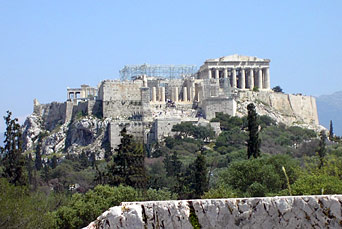
Major landmarks and culture-One amazing monument you should visit in Greece is the Acropolis of Athens. An Acropolis is a fortified hilltop. The Acropolis symbolizes the classical greek spirit and civilization. You should visit the Acropolis because it is the home of civilization as we know it. Below is a picture of the Acropolis.
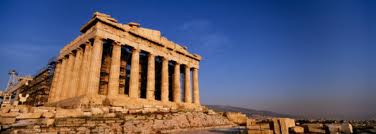
Another fantastic landmark is the Parthenon in Athens. The Parthenon stood atop the Acropolis for nearly 2,500 years. It was built to give thanks to Athena, the Goddess of Wisdom. The Parthenon was used mainly as a Greek temple, but was also used as a fortress and a church. The Parthenon is now one of the most popular tourist attractions in the world. You should visit the Parthenon because the view from it is amazing. Below is a picture of the Parthenon.
10 most important facts about Greece:
- From around 600 until 371 B.C., Sparta had the most powerful army in Greece.
- The Greeks invented the Olympic games. The first Olympic games were in 776 B.C.
- The Greeks invented drama as an art form and built the first theatre in the West.
- One of the greatest storytellers of all time was a blind man named Homer.
- The Greeks wrote about two kinds of drama: a tragedy, and a comedy.
- Pericles led Athens during its Golden Age. Pericles wanted to strengthen Athenian democracy, to hold and strengthen the empire, and to glorify Athens.
- The Hellenistic culture emerged as a result of Alexander's policies. The Hellenistic culture was a blending with Egyptian, Persian, and Indian influences.
- The Egyptian city of Alexandria became the foremost center of commerce and Hellenistic civilization.
- Hellenistic scholars perserved Greek and Egyptian learning in the sciences.
- Alexander the great conquered Persia, and gained control of Anatolia.
