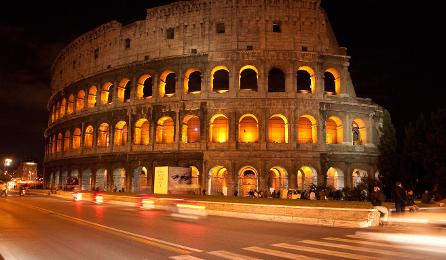
No Italian vacation is complete without a stop in Rome. Spring and fall are the best times to visit because of mild temperatures and sunny days. Rome was built on seven rolling hills at a curve on the Tiber River. It is midway between the Alps and Italy's southern tip. Rome is near the midpoint of the Mediterranean sea. To get to Rome you can fly directly into Rome, you can take a cruise that has a stop in Rome, or you can drive there from any city in Europe.
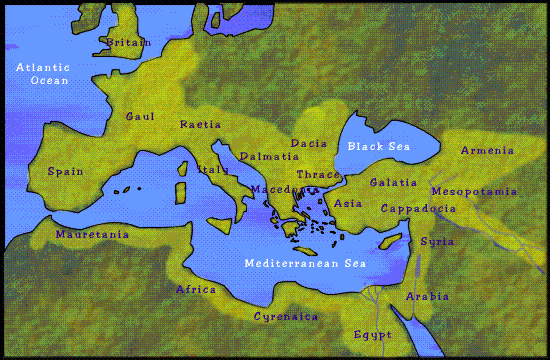
Religion: As the Roman Empire grew so did Christianity. Sometime around 6 to 4 B.C a Jew named Jesus was born in Bethlehem in Judea. At the age of 30 Jesus began his public ministry. He spent the next 3 years preaching, teaching, and reportedly performing miracles. Many of his teachings contained ideas from Jewish traditions such as monotheism, or belief in only one god. As Jesus continued to preach from town to town his fame grew. He attracted large crowds and many people were touched by his messages. Jesus' growing popularity concerned Roman leaders. When Jesus arrived in Jerusalem the Roman governor Pilate accused Jesus of defying the authority of Rome. Pilate arrested Jesus and ordered him to be crucified. After the death of Jesus, his followers continued to spread Christianity. Christianity soon spread throughout the Roman Empire. By the late third century A.D., there were millions of Christians in the Roman Empire. Christianity grew because it embraced all people, gave hope to the powerless, offered a personal relationship with a loving god, and promised eternal life after death. In Christianity a Bishop supervised several local churches. Eventually each major city had its own Bishop. An apostle named Peter became the first Pope who is the father of the Christian church. As Christianity continued its rise, the Roman Empire eventually began to decline. While you are in Rome do not miss the Vatican which is the home to the Catholic Church and the pope. While you are there you can see Michelangelo's Sistine celling, attend Mass, and maybe catch a look at the Pope.
Rulers and government-The last king of Rome was Tarquin the Proud, a harsh tyrant. He was driven from power in 509 B.C. The Romans said they would never be ruled by a king again. Instead, they established a republic, a form of government in which power rests with citizens who have the right to vote for their rulers. The people who held most of the power in Rome were the patricians. The other people were the plebeians, the common farmers, artisans, and merchants who made up most of the population.
Rome had 2 officials called consuls. They commanded the army and directed the government. The consuls term was only 1 year long and a person could not be elected for consul again for 10 years. The senate was the aristocratic branch of Rome's government. In times of crisis, the republic could appoint a dictator, a leader who had absolute power to make laws and command the army.
One of Rome's greatest military leaders was Julius Caesar. He joined forces with Crassus, a wealthy Roman, and Pompey. For the next 10 years these men dominated Rome as a triumvirate, a group of three rulers. Caesar was a strong and a genius military leader. Caesar led his legions in a successful campaign to conquer all of Gaul. When he conquered Gaul it made him very popular with the people of Rome. Pompey, who became Caesar's, rival ordered Caesar to return home. Caesar ignored the orders and took his army across the Rubicon River in Italy. He marched his army toward Rome, and Pompey fled. Caesar's troops defeated Pompey's army in Greece, Asia, Spain, and Egypt. In 46 B.C Caesar returned home. That same year, the senate appointed him dictator. In 44 B.C., he was named dictator for life.
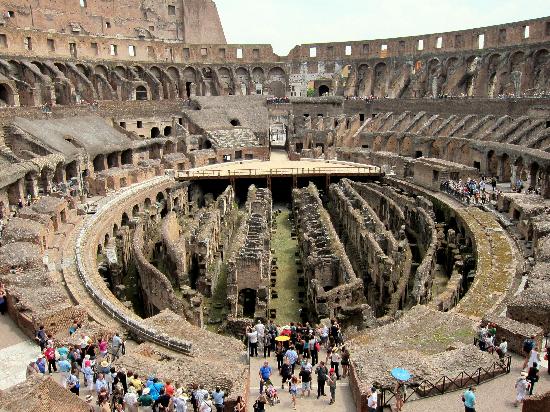
Major landmarks and culture: When you travel to Rome there are many historical landmarks you should visit. One interesting landmark is the Colosseum. During this time the Colosseum was a prime place for entertainment. The colosseum could fit about 55,000 people. There were four stories, and you sat depending on your gender and your social class. You should visit the Colosseum because it is one of Rome's greatest buildings. Below is a picture of the inside of the Colosseum.
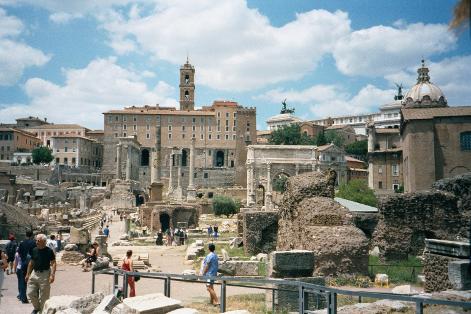
A fascinating landmark you should visit is the Roman Forum. The Roman Forum was the central area of the city around which ancient Rome developed. You should visit the Roman Forum because today it is one of the most important archeological sites in the world.
10 facts about Rome:
- The period of peace and prosperity in Rome was known as Pax Romana meaning "Roman peace".
- All citizens who owned land in Rome were required to serve in the army.
- Rome's economy suffered from an inflation which is a drastic drop on the value of money.
- The mixing of elements of Greek, Hellenistic, and Roman Culture produced a new culture, called Greco-Roman culture.
- Romans were great architects. They build aqueducts that were designed to bring water into the city.
- Rome's leaders allowed the plebeians to form their own assembly and elect representatives called tribunes. Tribunes protected the rights of the plebeians from unfair acts of patrician officials.
- The Romans made more use of slaves than any previous civilization.
- Christianity began to rise and spread through the empire.
- To defend against the increasing threats to the empire, the government began to recruit mercenaries who were foreign soldiers who fought for money.
- The best examples of Roman paintings are found in the Roman town of Pompeii.
